
Our review · RIO DE JANEIRO TOURS
Jewish Tour in Rio de Janeiro
Rio’s Jewish story is spread across fashionable beach districts, community buildings, synagogues, and quiet memorials. This three-hour Jewish heritage tour brings those pieces together by car, giving you context that a standard Rio sightseeing trip will usually skip. You see Beit Lubavitch, the CIB Jewish Community Center, the ARI synagogue, the Great Temple, and the Jewish Museum.
I like the personal side of the experience. Guides including Ephraim, Leonardo, and Gisella have strong ties to Rio’s Jewish community, and the best tours include personal explanations rather than a string of dates. I also like the easy transport: hotel or port pickup, an air-conditioned car or van, and a maximum group size of 14.
The main consideration is access. The Jewish Museum and Great Temple charge admission, and some sites may be open only at certain times. Itzhak Rabin Park has also been reported as temporarily inaccessible, so the exact balance of indoor and outdoor stops can change.
Key points to know before booking
- A Jewish view of Rio: Connect beach neighborhoods, synagogues, schools, memorials, and community institutions.
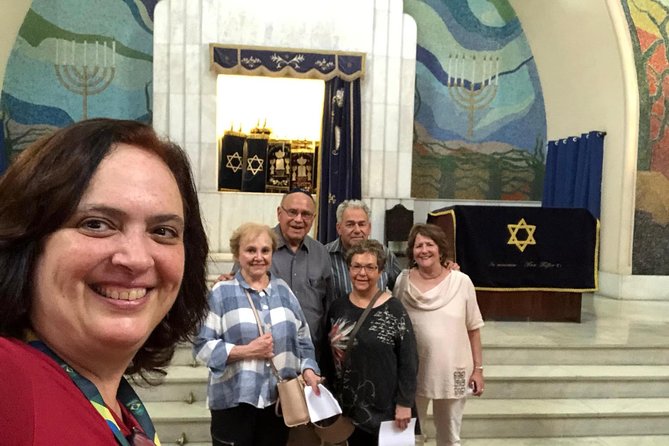
- Local guides matter: Ephraim, Leonardo, Gisella, and other guides bring local and personal context to the visit.
- Small-group transport: The tour caps participation at 14 people and uses a car or van.
- Four distinct Jewish settings: Expect Orthodox, Progressive, Ashkenazi, cultural, and community spaces.
- Admission costs extra: Entry fees for the Jewish Museum and Great Temple are not included in the $95 price.
- Allow some flexibility: Religious buildings and memorial sites may have changing opening arrangements.
Why Rio’s Jewish story works best by car
This tour is less about one grand museum and more about seeing how Jewish life fits into Rio itself. The route moves through Leblon, Ipanema, Copacabana, Botafogo, and Botafogo Bay, so the city remains part of the lesson. You are not tucked away in a single cultural center. You are crossing neighborhoods where Jewish institutions sit alongside beaches, apartment towers, schools, and public parks.
That matters because Rio’s Jewish community is not presented as a sealed-off world. The tour introduces different forms of Jewish life, including Orthodox and Progressive congregations, educational work, cultural programs, Holocaust research, and community services. You get a sense of how institutions serve both religious members and the wider public.
The vehicle also saves time. These places are scattered, and reaching them by taxi or public transport would take planning. Pickup is offered from selected hotels and from the port, with the published starting point at the Hilton Rio de Janeiro Copacabana at 9:00 a.m. Confirm your pickup details in advance, especially if you are coming from a cruise ship. One past departure became confusing because different passengers had different pickup times, so clear communication is important.
The group limit of 14 is a useful middle ground. You are not paying for a private tour, but you should have a better chance to ask questions than on a large coach. The vehicle is a key part of the experience, since the guide can explain Rio and its Jewish community while you travel between stops.
Other Rio de Janeiro days that go well with this one:
- Rio de Janeiro: 6-Stop Highlights of Rio with Lunch
★ 4.4 · 5,157 reviews - Christ the Redeemer Entry Ticket by Corcovado Train
★ 4.4 · 4,476 reviews - Rio de Janeiro: Rocinha Favela Walking Tour with Local Guide
★ 4.8 · 3,052 reviews
Leblon and Ipanema: Jewish life beside Rio’s famous beaches
The morning begins in Leblon, one of Rio’s most expensive neighborhoods. The beach is a useful reminder of the city’s sharp contrasts: high-priced homes, polished streets, and major religious and cultural institutions all occupy the same part of town.
At Beit Lubavitch Synagogue and the Midrash Cultural Center, you see an Orthodox presence in the city. The scheduled stop is about 20 minutes, and there is no admission fee listed. This is a short visit, but it helps establish that Rio’s Jewish community is not represented by one single style of worship.
The route continues through Ipanema. Ipanema Beach runs between Arpoador and Leblon and is one of Rio’s main centers of activity. The beach itself is not a formal museum stop, but it gives you a quick look at the setting in which local Jewish institutions operate. You may spend more time viewing the neighborhood from the vehicle than touring a specific building here.
The route also includes the CIB Jewish Community Center, located in the Ipanema area. This is one of the most useful stops for understanding present-day community life. The center is described as open to people of all faiths and includes facilities such as a gym, workout room, store, pharmacy, restaurant, games, and cards.
That range of services tells you something important. A Jewish community center can function as a social and practical gathering place, not only as a prayer hall. If the center is open during your visit, it may be one of the most revealing parts of the morning because it shows how community institutions support daily life.
Botafogo Beach and the Anne Frank school
Botafogo changes the mood. The beach offers one of Rio’s classic postcard views, with the bay and surrounding hills forming a dramatic setting. Here the Jewish story moves from worship and community services to education and public values.
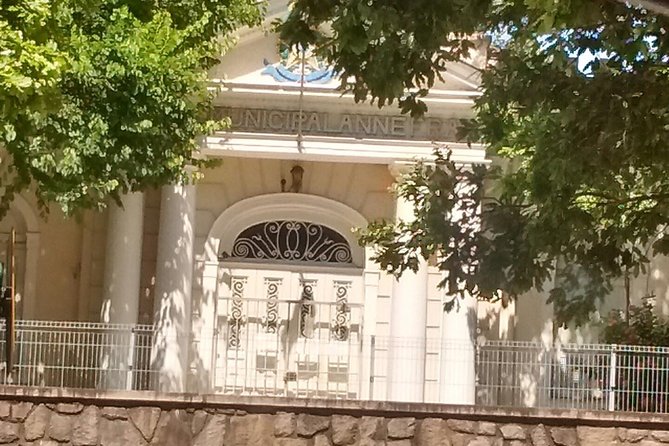
A municipal school in Botafogo carries Anne Frank’s name. It is part of a wider Network of Schools Anne Frank connected with CONIB and other organizations. The project uses Anne Frank’s example to promote peace, respect for differences, and human rights in Brazilian public schools.
This is a worthwhile detail because it places Jewish memory within Brazil’s public education system. You are not simply visiting a Jewish building. You are seeing how the memory of Anne Frank has been used to encourage civic values beyond the Jewish community.
The guide’s explanation makes a big difference here. A sign or school name alone gives you little context. A local guide can connect the site to Rio’s Jewish institutions and to the wider work of preserving memory. Guides such as Ephraim and Leonardo have been praised for adding personal examples and answering questions across many subjects, which is especially helpful at a brief outdoor stop.
ARI synagogue and Rio’s Progressive Jewish tradition
The ARI synagogue is another Botafogo stop, and it adds a different religious voice to the tour. Founded in 1942, the Israel’s Religious Association is affiliated with the World Union for Progressive Judaism.
The synagogue is part of the Rabbi Henry Lemle Community Center, which opened in 1997. Its facilities include classrooms, a library, auditorium, reception and administrative areas, plus the Henrique Peres synagogue, which can hold up to 150 people. The site also includes the Zinner Family Center for Reference and Research on the Holocaust.
This is one of the tour’s strongest stops because it links religious practice with learning and remembrance. You can see how a congregation may serve as a place for worship, education, research, and community events under one roof.
Access depends on the day and arrangements. A past visit found the Holocaust-related museum area closed, so you should not assume every room will be available on every departure. The tour provider may still explain the site and its role, but the physical visit can be less complete than expected.
One especially appealing possibility is attending a service separately. A guide once offered to take visitors to Shabbat services at ARI and introduced them to the rabbi and members of the congregation. This is not presented as a guaranteed part of the standard tour, so treat it as a possible extra rather than a promise. Still, it shows the value of having a guide with local connections.
A different side of Rio de Janeiro altogether:
- Rio: Christ the Redeemer, Sugarloaf, Selaron & BBQ Lunch
★ 4.5 · 2,428 reviews - Rio De Janeiro: Half-Day Rocinha Favela Walking Tour
★ 4.7 · 2,272 reviews - Rio de Janeiro: Angra dos Reis and Ilha Grande Full-Day Tour
★ 4.6 · 1,673 reviews - Rio de Janeiro: Beginner Samba Lesson in Ipanema
★ 4.9 · 1,071 reviews
Itzhak Rabin Park and the view over Botafogo Bay

Itzhak Rabin Park sits on Morro de Pasmado above Botafogo. The viewpoint looks across Botafogo Bay and toward Urca Bay, making this the tour’s clearest scenic pause.
The park was named for Israel’s former prime minister and was inaugurated by his wife, Leah Rabin. A bust of Rabin represents the relationship between Brazil and Israel. The setting gives political and diplomatic history a physical place in Rio, rather than leaving it as an abstract subject inside a synagogue.
The scheduled stop is about 20 minutes. Bring your camera, since the view is one of the better reasons to include this part of the route. But check current access conditions. One account found the park inaccessible at the time of the visit, so the stop may become a brief explanation or a viewpoint seen from another location.
This is also a good example of why you should keep expectations flexible. The tour includes several sites whose opening arrangements can change. The guide can still explain their meaning, but you may not always get the same amount of time outside or inside.
The Jewish Museum: small space, useful context
The Jewish Museum of Rio de Janeiro was founded in 1977 after the donation of a menorah. Its work focuses on preserving memory and presenting Jewish culture through religious, historical, and cultural programs.
The museum holds exhibitions on Rio’s Jewish community and Jewish traditions. It also supports research on migration and the Holocaust, runs student competitions, and maintains a study center, a video archive with more than 1,000 films, and a library.
The planned visit lasts about 30 minutes. That is enough for an introduction, but not enough for a long museum session. One visitor described the museum as a single room in an office building, which sets a useful expectation: this is not a large national museum with several floors of displays.
I would still give this stop real weight. Its small size does not mean the subject is small. A compact collection can provide the basic framework you need before visiting synagogues and community centers. It can also help you understand migration, religious traditions, and the way Rio’s Jewish community has preserved its own memory.
Admission is not included in the tour price. Ask about the current fee and opening status when you book or confirm the tour. If the museum is closed, the guide may provide explanations elsewhere, but you should not count on receiving the full museum visit.
The Great Temple of Israel and an unusual final stop
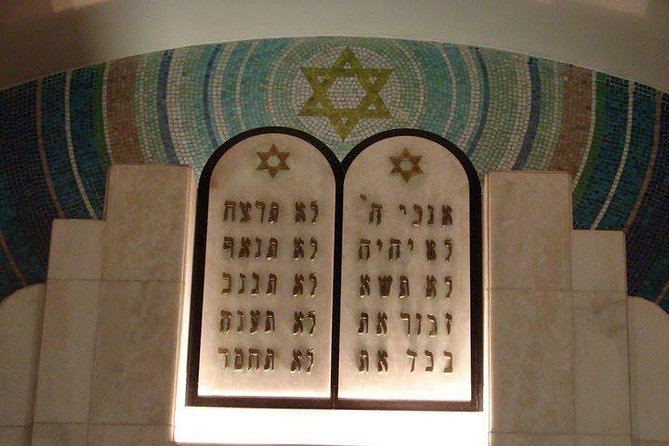
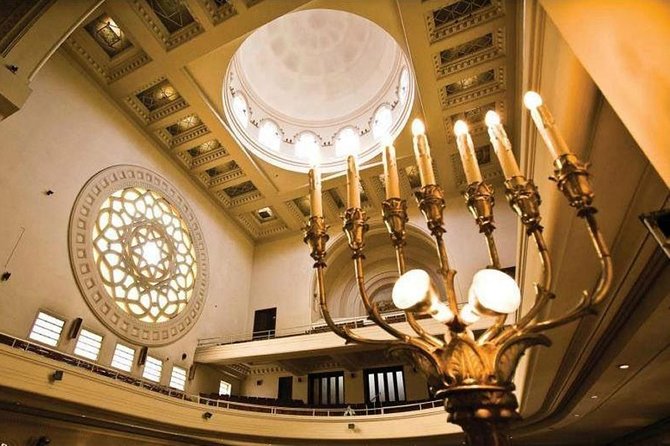
The Grande Templo Israelita do Rio de Janeiro is the largest Jewish monument in Rio’s community history. It is an Ashkenazi temple, built in an eclectic style that combines Hebrew elements with classical architecture.
The design was prepared in 1919 by architect Vodred, and the temple opened in 1932. Artist Humberto Cozzo created its mosaics in 1976. The building later collapsed in 1987 and is now open only during the High Holidays, special events, and tourist visits.
That limited access makes the stop unusual. You are not visiting a fully active synagogue on an ordinary weekday. Instead, you are seeing a historic building whose past use and present condition are part of the story.
The Great Temple is listed as a 30-minute stop, but admission is extra. Since access may be restricted, confirm whether the interior will be open on your date. If it is not, the exterior and the guide’s account may be the main experience.
For many people, the contrast between the Great Temple and ARI will be one of the morning’s best lessons. One represents an older Ashkenazi monument with a complicated physical history. The other shows an active Progressive institution with classrooms, research facilities, and community programs.
How the guides shape the morning
The strongest part of this tour is the guide’s ability to connect places that could otherwise feel unrelated. Ephraim has led many departures and is described as a longtime Rio Jewish local with teaching experience. Leonardo has also been praised for animated explanations and personal stories, while Gisella has worked both as guide and driver on some outings.
Guide quality can vary, and one poor experience involved a late start, unclear meeting arrangements, limited explanation in the vehicle, and confusion when a participant became separated from the group at the community center. The provider responded that the guide had gone looking for the person and that the group had been kept together, but the incident shows why you should listen carefully to meeting instructions.
Ask where the group will regroup before entering any building. Keep your phone with you, and tell the guide if you need to step away. These are sensible habits on any small-group city tour, particularly when the schedule is tight.
The better departures appear to offer more than the minimum route. Guides have sometimes pointed out other parts of Rio, answered questions outside the formal subject, arranged introductions, or suggested a local restaurant. Those extras are not guaranteed, but they can turn a short sightseeing run into a more personal introduction to the city.
Is $95 a fair price?
At $95 per person, this is not the cheapest way to see Rio. The value comes from the logistics and access, not from the number of included attractions. You are paying for a professional guide, vehicle transport, hotel or port pickup at selected locations, and a route that would be awkward to organize independently.
The price is easier to justify if you are staying in Copacabana, Ipanema, or Leblon, or if you are visiting from a ship. It is also useful if you want to compare several Jewish traditions in one morning rather than visit one synagogue on your own.
The value is less clear if you mainly want a large museum collection or guaranteed interior access at every stop. The tour lasts about three hours, and admission fees are separate. Some of the most important sites may be viewed briefly or from outside.
Food and drinks are not included. Children must be accompanied by an adult, and most people can participate. Free cancellation is available up to 24 hours before the start time, but changes or cancellations inside that window are not refunded.
Who should book this Rio Jewish tour?
I would choose this experience if you want Jewish context built into a first visit to Rio. It suits couples, families, and friends who prefer a guided morning to arranging several taxis and calling institutions one by one.
It is especially useful for people interested in synagogue architecture, Jewish migration, Holocaust education, community life, or the relationship between Brazil and Israel. You do not need to belong to a particular Jewish denomination. The route includes Orthodox, Progressive, Ashkenazi, educational, and cultural settings.
I would be more cautious if your priority is a long museum visit, an in-depth academic seminar, or a private schedule. Three hours passes quickly, and traffic, pickup coordination, and changing access can reduce time at individual sites.
FAQ
How long does the Jewish Tour in Rio de Janeiro last?
The tour lasts approximately three hours. The listed stops range from about 20 to 30 minutes, with the remaining time used for driving between neighborhoods.
Where does the tour start?
The published meeting point is the Hilton Rio de Janeiro Copacabana at Av. Atlântica, 1020. The listed start time is 9:00 a.m., and the activity ends back at the meeting point.
Is hotel pickup included?
Hotel pickup and drop-off are included for selected hotels. Port pickup and drop-off are also included, but you should confirm the exact meeting time and location before departure.
How many people can join the tour?
The group can include a maximum of 14 participants. Transport is provided by car or van.
Are entrance fees included in the $95 price?
No. Food, drinks, and entrance fees are not included. Admission is specifically listed as extra for the Jewish Museum and the Great Temple of Israel.
Can I cancel for a full refund?
Yes. You can cancel at least 24 hours before the experience starts for a full refund. Cancellations or changes made less than 24 hours before the start time are not accepted for a refund.
Should you book it?
Book this tour if you want local Jewish perspective plus easy Rio transport. Its best features are the range of institutions, the chance to compare different congregations, and guides such as Ephraim and Leonardo who can add personal context to the places you see.
Go in expecting a focused introduction, not a large museum experience or a guaranteed look inside every building. Confirm pickup details, ask about current access to Itzhak Rabin Park and the museums, and budget separately for admission. With those limits in mind, the tour offers a practical and meaningful way to see a side of Rio that ordinary city sightseeing leaves out.
New in Rio de Janeiro this month
- Discover Rocinha: Guided Tour of the Famous Favela★ 4.5 · 3 reviews
- Rio de Janeiro: Hang gliding adventure★ 3.7 · 3 reviews
- Rio de Janeiro: Pedra Bonita & Tijuca Forest Hike Tour★ 5.0 · 3 reviews
- Rio de Janeiro: Hang Gliding or Paragliding Flight★ 5.0 · 3 reviews
- Rio de Janeiro: Local Experience in Forró dance★ 5.0 · 3 reviews
- Rio de Janeiro: Doors-off 30-min helicopter tour★ 5.0 · 3 reviews
- Rio de Janeiro: Pedra do Telégrafo; Grumari/ Prainha Beaches★ 5.0 · 3 reviews
- Rio de Janeiro: Sugar Loaf with Lunch and Helicopter Flight★ 4.7 · 3 reviews
Rio de Janeiro Tours, compared.

Rio de Janeiro: 6-Stop Highlights of Rio with Lunch
Read our review →
Christ the Redeemer Entry Ticket by Corcovado Train
Read our review →
Rio de Janeiro: Rocinha Favela Walking Tour with Local Guide
Read our review →
Rio: Christ the Redeemer, Sugarloaf, Selaron & BBQ Lunch
Read our review →
Rio De Janeiro: Half-Day Rocinha Favela Walking Tour
Read our review →
Rio de Janeiro: Angra dos Reis and Ilha Grande Full-Day Tour
Read our review →
Rio de Janeiro: Beginner Samba Lesson in Ipanema
Read our review →