
Our review · RIO DE JANEIRO TOURS
Jeep Adventure: Guided Tour through Tijuca Rain Forest
Rio’s Tijuca Rain Forest gives you an unusual travel experience: within about ten minutes of the city center, tall forest replaces traffic and high-rises. This four-hour tour combines an open Jeep ride with a gentle walk to waterfalls, plus stops at lookouts and historic sites.
I like the easy access and the strong mix of nature and city views. I also like that guides explain the Mata Atlântica ecosystem, reforestation, wildlife, and Brazilian history rather than simply driving you from one photo stop to another. The main drawback is expectation: this is a forest outing, not a safari, and animal sightings are never guaranteed.
Key points to know before booking

- A quick escape from Rio: Tijuca National Park begins only about ten minutes from the city center.
- An easy forest walk: The hike takes roughly 15 to 30 minutes on a gradual trail and reaches Cachoeira dos Macacos.
- Excellent viewpoints: Vista Chinesa looks toward Ipanema, Copacabana, Guanabara Bay, and Niterói.
- More than trees: You’ll see waterfalls, Mayrink Chapel, the Visitor Center, and Emperor’s Table.
- Guide quality matters: Past guides named Eddie, Everton, George, Lucy, Andrea, Mario, Myriam, and others were praised for clear explanations and friendly help.
- Check the day: Vista Chinesa cannot be visited on Saturdays, Sundays, or holidays because of forest regulations.
Why Tijuca Forest makes a smart Rio side trip
Rio is famous for beaches, granite peaks, and city views, but Tijuca offers a different look at the city. The forest is not far-flung wilderness. It is a protected green area pressed against the urban core, making it a practical choice if you have only half a day.
The tour focuses on the Mata Atlântica, the Atlantic Forest ecosystem that once covered much of Brazil’s eastern coast. Your guide explains its plant life, animals, and importance within the Mata Biosphere Reserve, which reaches across 14 Brazilian states.
The reforestation story adds meaning to the ride. You are not simply passing through attractive woods. You are seeing a protected forest that exists close to one of South America’s largest cities because of long-term conservation and replanting work.
I would choose this outing early in a Rio visit if I wanted a calmer introduction to the city. It gives you orientation from above, a taste of local history, and a chance to see how closely Rio’s urban life and forest are linked.
more tijuca forest days
- Rio de Janeiro: Christ, Selaron Steps, and Tijuca Park Tour
★ 4.7 · 857 reviews - Rio de Janeiro: Guided Jeep Tour through Tijuca Rainforest
★ 4.3 · 740 reviews - Rio: Tijuca Forest Small Group Hike to Caves and Waterfalls
★ 4.9 · 536 reviews
The open Jeep ride: fun, but not luxurious
Pickup is available from selected hotels in Downtown Rio, the South Zone, and Barra da Tijuca. From there, you meet the guide and driver and settle into an open-top Jeep for the short trip toward the park.
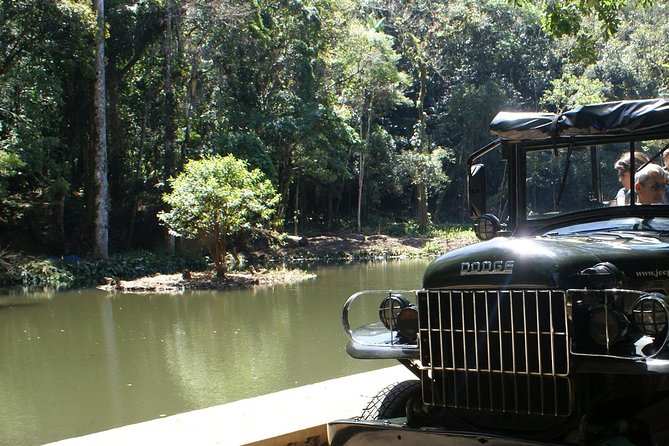
The open vehicle is part of the appeal. You get natural air, a better sense of the forest around you, and a more memorable ride than you would in a sealed minibus. It also makes the outing feel more like a small adventure than a standard sightseeing transfer.
There is a tradeoff. The Jeep uses small bench-style seats, which some people find cramped or uncomfortable. The vehicle is mainly useful for moving between forest sites and viewpoints, not for an extended wildlife drive deep into the woods. If you expect an African-style game ride, you may feel that the Jeep is more theatrical than necessary.
The maximum group size is 20 people. That is small enough for a guide to speak with the group, though the experience will not feel private. Pickup delays can also affect the morning. One reported departure involved a wait of nearly 30 minutes for late passengers, so avoid placing an important timed activity immediately afterward.
Tijuca National Park and the Visitor Center
The first substantial stop is Tijuca National Park, where the guide introduces the forest and its reforestation program. This opening explanation helps you understand why a large patch of forest survives so close to central Rio.
The Visitor Center receives a short visit of about 15 minutes. It is a useful stop for local biodiversity and gives the outing some structure before the walking portion begins. Do not expect a long museum visit. The value comes from the guide’s explanation and from putting the rest of the forest into context.
This is also where the tour works best for curious first-time visitors. Guides have been praised for explaining plants, animals, Brazilian history, and the forest’s past in clear terms. Several guides, including Eddie, Everton, George, Lucy, and Andrea, have received especially warm praise for making time for questions and helping with photographs.
Guide quality can vary from departure to departure, of course. The operator lists English, Spanish, German, Italian, French, and Portuguese, but communication during pickup deserves careful attention. Confirm your hotel location and departure details before the day begins.
Cascatinha Taunay and the forest walk
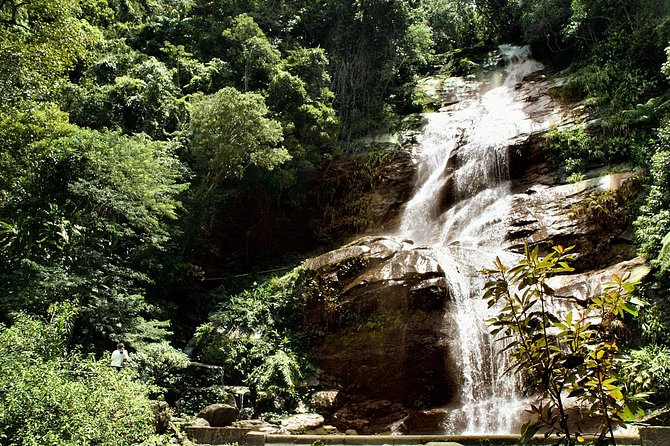
Cascatinha Taunay is one of the prettiest quick stops. You walk to the clear waterfall, take photographs, and get your first close look at the forest’s water and plant life.
The main walk is gentle. The stated walking time ranges from 15 to 30 minutes, and the trail is gradual rather than strenuous. Comfortable shoes are still important because this is a natural path, not a paved city promenade.
The route also includes Cachoeira dos Macacos, sometimes called the Waterfall of the Monkeys, and Cachoeira dos Primatas. These names may create a big expectation, but they refer to forest sites rather than a promise of animal sightings. You might see monkeys, sloths, butterflies, birds, a coati, lizards, hummingbirds, or other small creatures. You might also see only plants and hear animals without spotting them.
That uncertainty is part of the outing’s honest appeal. I would book it for the forest, waterfalls, and guide commentary first, with wildlife as a bonus. One person hoping for frequent animal encounters found the tour less satisfying, while others enjoyed spotting a coati, vultures, hummingbirds, fish, and smaller creatures.
more Rio de Janeiro days to choose between
- Rio de Janeiro: Rocinha Favela Walking Tour with Local Guide
★ 4.8 · 3,052 reviews - Rio de Janeiro: Favela Santa Marta Top Tour with Local Guide
★ 4.9 · 488 reviews - Rio de Janeiro: Favela Santa Marta Tour with Resident Guide
★ 4.6 · 220 reviews - Rio: Favela Rocinha Tour with Local Guide & Secret Spots
★ 4.7 · 218 reviews
Emperor’s Table and the view over Rio
Emperor’s Table sits about 487 meters above sea level. The site is linked with Dom Pedro I, who reportedly came here for meals and the view from Estrada da Vista Chinesa.
The stop offers a useful contrast to the waterfalls. Here, you look outward across Rio rather than inward at the trees. The city and forest meet in one frame, which makes this a particularly good place to take photographs.
The site is reached by stairs around the parapet and a concrete ramp leading toward the edge. It is a short stop, usually about ten minutes, so you will not have a long period to linger. On weekends, access may require walking because of road restrictions, so be ready for a little extra effort if you visit then.
The timing also matters. The tour information says Vista Chinesa is unavailable on Saturdays, Sundays, and holidays because of forest regulations. Emperor’s Table may still be included, but access conditions can differ. If the Chinese-style lookout is a priority, book a weekday that is not a holiday.
Mayrink Chapel: a small historical surprise

Mayrink Chapel is easy to miss if you are focused only on scenery. The small pink building sits among the trees at about 460 meters above sea level and dates to 1860.
The chapel was built inside the former farm of the Portuguese banker Viscount de Souto. Its altar includes reproductions of religious panels by Cândido Portinari. The grounds also connect to the work of landscape designer Roberto Burle Marx, including the gardens, Carrara marble, and tiled patio basin.
You stop for only about five minutes, and the chapel may not always be open for a long interior visit. Still, it is a worthwhile pause because it shows another side of Tijuca. The forest is not only a natural refuge. It also contains traces of Rio’s estates, religious life, and artistic traditions.
I like this stop because it breaks up the sequence of lookouts and waterfalls. The scale is intimate, and the pink facade makes a striking photograph against the surrounding greenery.
Vista Chinesa and Rio’s best forest panorama
Vista Chinesa is the headline viewpoint for many people. The pagoda-style lookout was built between 1902 and 1906 to honor the Chinese people who brought tea cultivation to Brazil in the early 19th century.
Made from bamboo and cement, the structure sits at roughly 380 meters above sea level. From here, you can look across Ipanema and Copacabana, Guanabara Bay, and, on a clear day, toward Niterói.
This is where the tour delivers its strongest city photographs. The viewpoint lets you see Rio as a whole rather than as separate beaches and neighborhoods. Weather makes a real difference. In rain or low cloud, the forest remains appealing, but the distant view may fade. A few people still found the outing worthwhile in wet conditions because the forest itself looked fresh and dramatic.
The short stop lasts about ten minutes. That is enough for photographs, but not enough for a slow, contemplative visit if the group is large. Keep your camera ready and listen for the guide’s signal before returning to the Jeep.
What the guide adds to the experience

This tour depends heavily on the person leading it. The best guides turn a short drive and easy walk into a lesson about Rio’s plants, animals, history, and conservation.
Guides named in past departures include Eddie, Everton, George, Lucy Morozini, Andrea, Mario, and Myriam. Eddie was praised for detailed explanations about the forest and the country. Everton was noted for covering the park thoroughly and speaking several languages. George was described as both funny and well informed about local plants and wildlife.
Lucy Morozini received praise for explaining things clearly and answering questions. Andrea helped a solo visitor with photographs and offered practical suggestions for another excursion. These details matter if you are traveling alone or want more than a scripted bus commentary.
The driver is also important. The service includes a separate driver, and past departures praised drivers for arriving on time and keeping the ride safe. Still, pickup communication has been the weak point in some cases. A few people waited at the stated hotel and later learned they were expected at another property. Confirm the exact pickup point, not just the neighborhood.
Is the $88.21 price fair?
At $88.21 per person, this is not the cheapest way to see a patch of forest. You are paying for roundtrip hotel transport, a guide, the open Jeep, park access, and a tightly arranged half-day route.
The price makes better sense if your hotel is in Downtown, the South Zone, or Barra da Tijuca and you want someone else to handle transport. It also offers good value if you want several sights in one morning: waterfalls, a chapel, two viewpoints, the Visitor Center, and an easy walk.
The value is weaker if you mainly want a long hike or a dedicated animal-spotting trip. The outing lasts about four hours, but walking time is modest and the Jeep does not function as a safari vehicle. Food and drinks are not included, so eat beforehand and bring water.
With an overall score of 4 out of 5 from 554 ratings, the experience appears broadly successful but not flawless. The strongest pattern is praise for the guides, the views, and the ease of fitting the forest into a busy Rio schedule. The sharpest complaints concern missed pickups, unclear communication, double charges, and expectations about wildlife.
Who should book this Tijuca tour?
I would recommend it to you if you want a manageable nature outing without giving up most of a day. It suits first-time visitors, couples, families, solo sightseers, and anyone who prefers an easy walk to a demanding hike.
It is also a good fit if you enjoy history and photography. Mayrink Chapel and Emperor’s Table add cultural interest, while Vista Chinesa gives you a wide view over Rio’s beaches and bay.
I would be cautious if you have back-to-back plans, dislike bench seating, or expect frequent monkey and sloth sightings. I would also avoid booking it without confirming pickup details. The tour can be excellent once it starts, but a missed vehicle or unclear meeting point can spoil a short vacation morning.
Wear comfortable clothes and shoes. Bring water, sunscreen, sunglasses, and a hat. Choose a weekday if Vista Chinesa is important, and allow some flexibility after the four-hour estimate in case hotel pickups run late.
Final call: a practical Rio nature outing
Book this tour if you want an efficient introduction to Tijuca Forest, with clear city views and a guide who can explain what you are seeing. The combination of an easy walk, waterfalls, historic stops, and an open-air ride gives you a pleasant change from Rio’s beaches and major monuments.
Just set the right expectation. You are signing up for a guided forest walk with scenic stops, not a wildlife safari. Confirm the pickup location, check the weekday restriction for Vista Chinesa, and bring water. With those details handled, this is a worthwhile half-day choice for seeing Rio’s green side without a strenuous trek.
FAQ
How long does the Tijuca Rain Forest tour last?
The experience lasts approximately four hours, including hotel pickup and drop-off, the Jeep ride, forest visits, short walks, and viewpoint stops.
Is hotel pickup included?
Yes. Roundtrip pickup and drop-off are included from most hotels in Downtown Rio, the South Zone, and Barra da Tijuca. Pickup availability depends on the hotel location.
How difficult is the hike?
The hike is described as easy, with a gradual trail taking about 15 to 30 minutes. Comfortable clothing and shoes are recommended.
Can I visit Vista Chinesa on a weekend?
No. Due to forest regulations, Vista Chinesa is not available on Saturdays, Sundays, or holidays.
What languages are available?
The tour is available in English, Spanish, German, Italian, French, and Portuguese.
Are food and drinks included?
No. Food and drinks are not included. Bring a bottle of water, especially in hot weather.
What wildlife might I see?
You might see sloths, monkeys, butterflies, birds, coatis, lizards, hummingbirds, vultures, or fish. Sightings are not guaranteed.
How many people can join the tour?
The maximum group size is 20 people.
New in Rio de Janeiro this month
- Discover Rocinha: Guided Tour of the Famous Favela★ 4.5 · 3 reviews
- Rio de Janeiro: Hang Gliding or Paragliding Flight★ 5.0 · 3 reviews
- Rio de Janeiro: Hang gliding adventure★ 3.7 · 3 reviews
- Rio de Janeiro: Pedra Bonita & Tijuca Forest Hike Tour★ 5.0 · 3 reviews
- Rio de Janeiro: Local Experience in Forró dance★ 5.0 · 3 reviews
- Rio de Janeiro: Doors-off 30-min helicopter tour★ 5.0 · 3 reviews
- Rio de Janeiro: Pedra do Telégrafo; Grumari/ Prainha Beaches★ 5.0 · 3 reviews
- Rio de Janeiro: Sugar Loaf with Lunch and Helicopter Flight★ 4.7 · 3 reviews
Rio de Janeiro Tours, compared.

Rio de Janeiro: 6-Stop Highlights of Rio with Lunch
Read our review →
Christ the Redeemer Entry Ticket by Corcovado Train
Read our review →
Rio de Janeiro: Rocinha Favela Walking Tour with Local Guide
Read our review →
Rio: Christ the Redeemer, Sugarloaf, Selaron & BBQ Lunch
Read our review →
Rio De Janeiro: Half-Day Rocinha Favela Walking Tour
Read our review →
Rio de Janeiro: Angra dos Reis and Ilha Grande Full-Day Tour
Read our review →
Rio de Janeiro: Beginner Samba Lesson in Ipanema
Read our review →
Browse the lists this tour appears in