
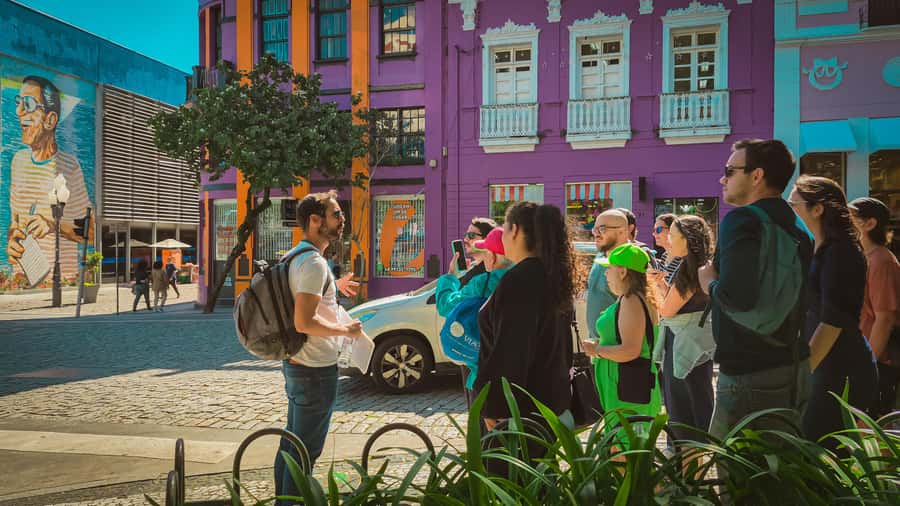
Our review · FLORIANÓPOLIS TOURS
Florianopolis: Walking Tour – History, Art and Gastronomy
Florianopolis reveals its story best on foot, and this tour links the city’s Indigenous, Portuguese and African roots with the food and drink of its old center. You’ll move from the cathedral and imperial palace to Black heritage sites, the Public Market and a final bar stop, with plenty of context along the way.
I like the small, social feel suggested by the plan to meet people from different countries, and I like the practical finish: food, beer and bar suggestions you can use that same evening. The guide Isaac is praised for clear English, an easy manner and strong knowledge of both Brazil and Floripa.
The main consideration is pace. You’ll walk for about two hours, and food and drinks cost extra. If you want long interior visits or a quiet museum tour, this is not that kind of experience.
Key points before you book
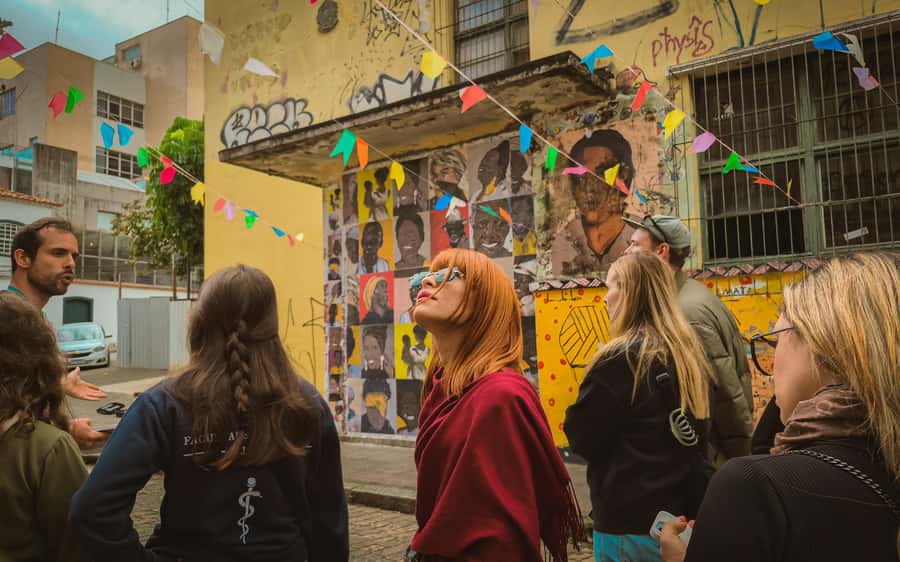
- History tied to real city streets: Learn how Indigenous groups, Portuguese colonists and enslaved Africans shaped Santa Catarina Island and Florianopolis.
- A food stop with local flavor: Try pastéis, coxinhas, sugar cane juice and local beer, with a pint costing about $4 on average.
- A useful final stop: The tour ends at the Public Market, where you receive ideas for what to eat, drink and do next.
- Three language options: The live guide speaks English, Portuguese and Spanish.
- Rain backup included: Rain coats are supplied if the weather turns wet.
- Good access for many visitors: The tour is listed as wheelchair accessible, though you should still expect steady walking and comfortable shoes are essential.
A city story that starts at the Alfândega
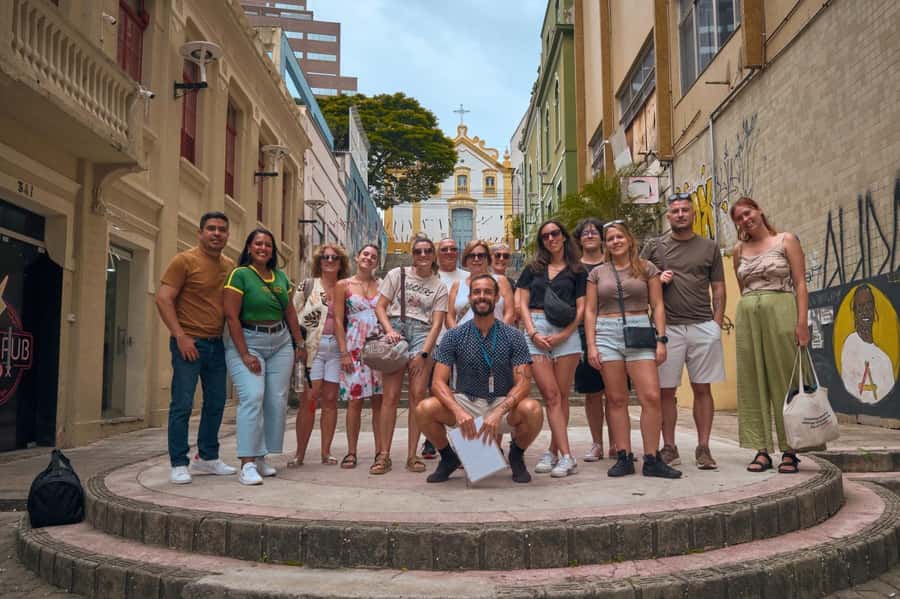
You meet outside café|bar do Largo d’Alfândega, a local coffee shop near the starting point. This is a practical meeting place because you can buy a coffee and use the restroom before setting off.
Look for the guide wearing a white T-shirt marked The Best of Florianopolis, carrying a guide credential and using a small colorful umbrella. That last detail matters in a busy historic center. It gives you an easy visual marker as the group moves from one stop to the next.
The opening section sets up the whole tour. Instead of treating Florianopolis as only a beach destination, the guide explains how the island’s society and economy took shape. You hear about the Indigenous groups who lived on Santa Catarina Island, then move into the arrival of Portuguese colonists in the 17th century and the forced arrival of enslaved Africans.
That broad frame gives the buildings more meaning. A church is not just an old church. A public square is not just a place for photographs. Each stop becomes part of a story about power, labor, religion, migration and social change.
more history walks in Florianópolis
- Florianópolis: Historical Center, Beach & Nature Tour
★ 3.3 · 25 reviews - Rio de Janeiro: Historic Rio and Santa Teresa Half-Day Tour
★ 4.4 · 228 reviews - São Paulo: Downtown Historical Bike Tour
★ 4.9 · 191 reviews
Catedral Metropolitana and the old center
The Catedral Metropolitana de Florianópolis Nossa Senhora do Desterro e Santa Catarina de Alexandria receives about 20 minutes of guided attention. It is one of the most important early landmarks in the center, and it gives the guide a natural place to explain Portuguese influence and the role of Catholic institutions.
I would pay attention here even if you are not especially interested in church architecture. The cathedral helps establish how colonial cities were organized, with religious buildings anchoring public life. The guide also uses the stop to connect the city’s earlier name, Nossa Senhora do Desterro, with the later identity of Florianopolis.
The tour is designed around explanation rather than a long silent visit. You’ll likely hear the main points, look at the building and continue. That works well for a first orientation, but anyone hoping for a detailed architectural study should keep expectations modest.
Cruz e Sousa Palace and Praça XV
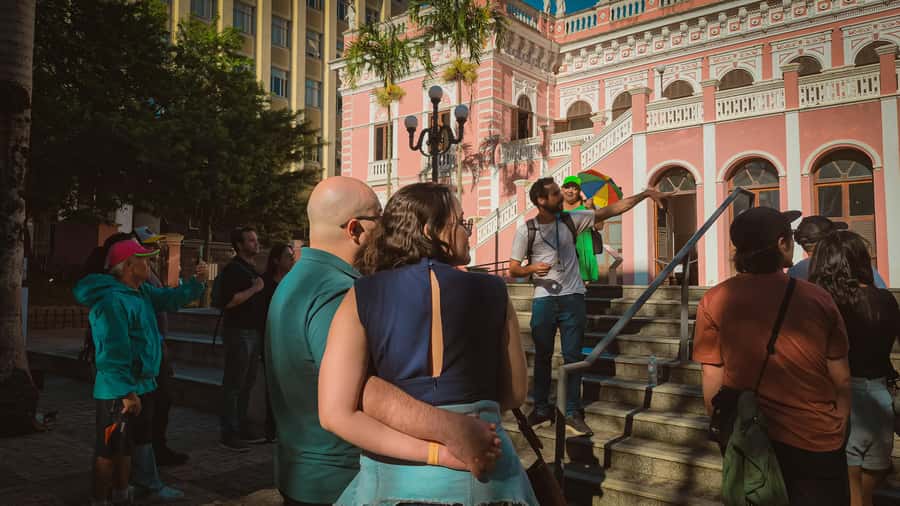
The next stop is Palacio Cruz e Sousa, with about 10 minutes of commentary. This building is tied to the former center of political and social authority in the city. Its inclusion helps you see Florianopolis through more than churches and colonial streets.
The palace is named for Cruz e Sousa, one of Brazil’s major Black poets. That makes the stop especially useful because the tour does not treat Black history as a footnote. It links the building and the poet to the wider social story of the city.
From there, you move to Praça XV de Novembro for another 10 minutes. Squares such as this are useful reading points in an old city. They show how public life, government, ceremony and everyday movement gathered in one place.
The time here is short, so bring questions. A walking tour works best when you use the guide to fill in the gaps between visible details. You get a clearer sense of where Florianopolis concentrated authority, and where different groups were included or pushed aside.
Fernando Machado Square and Black Florianopolis
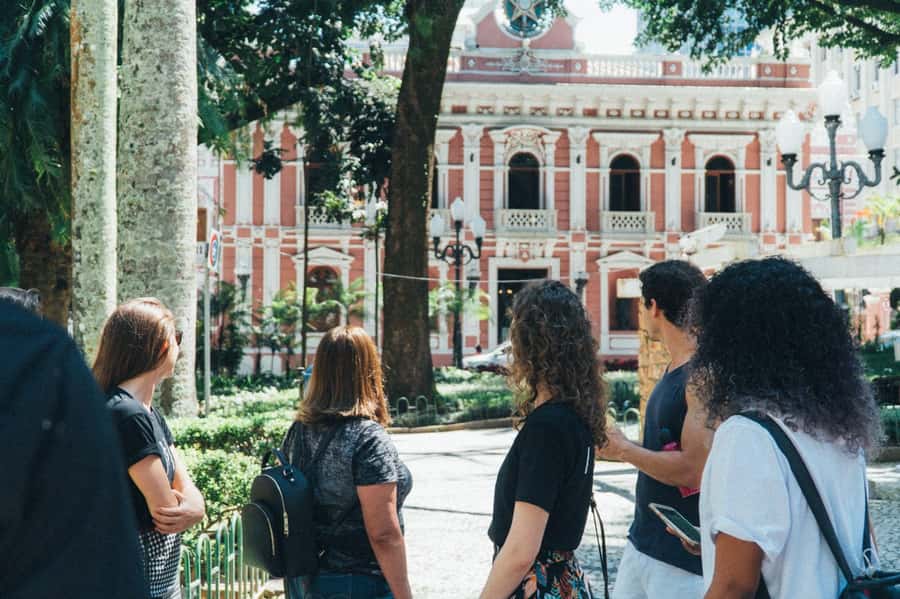
Praça Fernando Machado receives another 10-minute explanation. This stop continues the move from official monuments to the people who worked, worshipped and built the city.
The route also passes landmarks important to Florianopolis’s Black community. This is one of the strongest features of the experience. Many city tours give most of their attention to colonial founders and grand buildings, while this one makes room for the Black presence in the city’s past and present.
The value is not only historical. It helps you read the center with sharper eyes. Streets and squares can look neutral until you learn whose labor made them possible and whose stories were left out of older versions of local history.
Because the schedule is tightly arranged, the commentary will be a guided overview rather than a full academic treatment. Still, the focus gives the tour more substance than a route based only on taking pictures of attractive facades.
more walking tours in Florianópolis
- Rio de Janeiro: Rocinha Favela Walking Tour with Local Guide
★ 4.8 · 3,052 reviews - Rio De Janeiro: Half-Day Rocinha Favela Walking Tour
★ 4.7 · 2,272 reviews - Sunrise and Sunrise Walk Two Brothers with Local Guide
★ 5.0 · 193 reviews - Rio de Janeiro: Little Africa Heritage Walking Tour
★ 4.9 · 177 reviews
The Public Market, where the tour turns to food

The Mercado Público de Florianópolis receives about 30 minutes, making it one of the longest stops. That is a wise choice. The market is both a historic meeting place and a practical introduction to local eating and drinking.
Here you can sample local snacks such as pastéis and coxinhas, drink sugar cane juice, and try local beer if you choose. These purchases are not included in the $18 price, so plan to carry extra money. An average pint costs about $4, though your total will depend on what you order.
Pastéis are filled pastries, often eaten as a quick snack. Coxinhas are savory fried snacks with a distinctive teardrop shape. Sugar cane juice offers a nonalcoholic option, while beer fits the social side of the tour.
The market stop is not just a snack break. It shows how food fits into daily life in Brazil. You get a chance to ask what to order, see where locals gather and note places to return after the tour.
The route finishes at the Public Market, so you are not left searching for your next stop. If you are hungry, you can continue eating there. If you want to explore the center on your own, the guide provides a city map with local recommendations.
Álvaro de Carvalho Theatre and Avenida Hercílio Luz
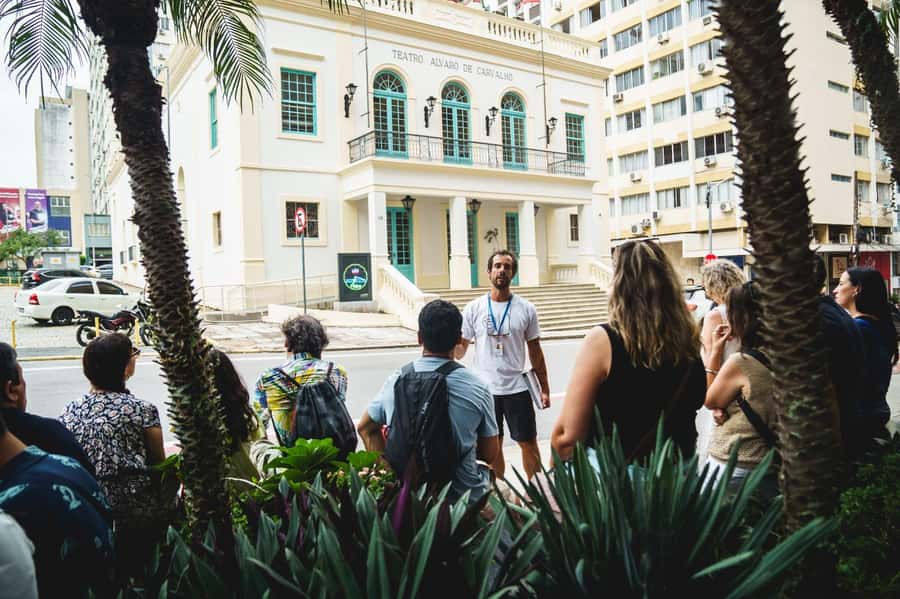
The Álvaro de Carvalho Theatre receives about 10 minutes of guided attention. It is described as one of the city’s most beautiful monuments, and the stop adds culture and performance to a route otherwise focused on government, religion, public squares and food.
A short visit is enough to appreciate the facade and understand the theatre’s place in Florianopolis. It is not a performance visit, so you should not expect to attend a show or spend a long time inside.
The group then continues along Avenida Hercílio Luz for about 10 minutes. This section gives you a change of scale, moving away from the tight cluster of the old center and into one of the city’s notable avenues.
Walking between these locations is part of the point. You see how the historic core connects to later city development instead of experiencing each monument as an isolated stop. Wear shoes that can handle steady pavement walking, and choose comfortable clothes as advised.
Forte de Santa Bárbara and the final bar stop

Forte de Santa Bárbara receives about 10 minutes. The fort adds a military layer to the city story, showing that Florianopolis was shaped not only by churches, palaces and markets but also by defense and strategic control.
Again, the stop is brief. Think of it as a piece in a larger picture rather than a full fort visit. The guide explains why the site matters, then keeps the group moving toward the final social part of the outing.
The scheduled visit to Bar do Noel takes about 40 minutes, the longest single stop. This is where the tour shifts most clearly from history to local food and nightlife. You may have the chance to enjoy more snacks or a beer, but these purchases are extra.
The bar stop also gives you time to talk with the guide and other people in the group. That can be useful if you are new to Florianopolis and want ideas for the evening. Isaac, one of the guides associated with the experience, is specifically praised for offering food and bar suggestions, speaking clear English and explaining Brazil and Floripa in an easy-to-follow way.
The guide may even join you at one of the city’s bars after the official tour. That is not something to treat as guaranteed, but it points to the informal tone of the experience.
What the $18 price really buys

At $18 per person, this is priced as an affordable introduction rather than a full-day cultural program. You are paying for roughly 2 to 2.5 hours of guided walking, several historic stops, food orientation, a city map and the chance to ask a local guide for practical advice.
The strongest value comes from the connections between stops. You are not simply paying to be led from one photo point to another. The guide explains social and economic formation, Indigenous history, Portuguese colonization, African enslavement and Black community landmarks, then brings the story into present-day markets and bars.
Food and alcohol are separate costs. That is fair for a flexible group tour, since you can decide how much to eat or drink. Still, budget beyond the ticket if you want to try several snacks and a pint.
The rain coat provision is a small but useful extra in Florianopolis, where weather can change. The free cancellation option up to 24 hours before the start and the reserve-now, pay-later choice also make it easier to fit the tour into a changing schedule.
Who will get the most from this walk
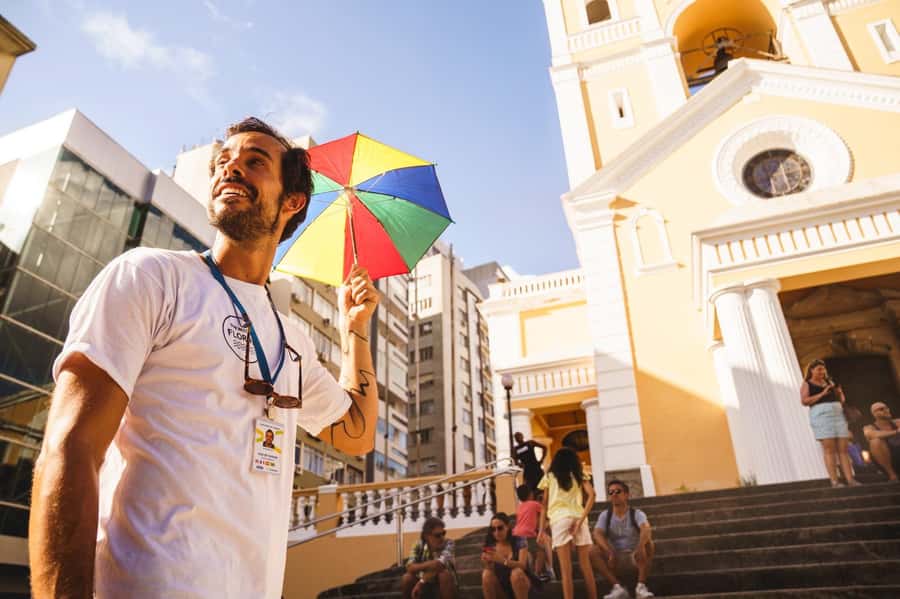
I would choose this tour if you are staying in Florianopolis for the first time and want a quick orientation to the historic center. It is also a good fit if you care about how Brazil’s Indigenous, European and African histories meet in one city.
The tour suits solo visitors and people who enjoy meeting an international group. The food and bar stops make it more social than a standard monument walk, while the map and recommendations help you plan the rest of your stay.
It is a sensible pick for English, Portuguese or Spanish speakers. The guide named Isaac receives especially strong praise for his English, clarity and friendly approach, though guide assignment can vary.
Wheelchair access is listed, which is important information for visitors who need it. Even so, you should confirm any specific mobility needs when booking, since the experience involves moving between multiple outdoor locations. Everyone should wear comfortable shoes.
You may want a different experience if you dislike group pacing, avoid all food and drink stops, or want long visits inside each building. The 10-minute stops are designed to build a connected story, not to provide detailed study of every monument.
A practical way to enjoy the afternoon
Arrive a little early at Café|Bar do Largo d’Alfândega. You can use the restroom, buy coffee and find the guide without rushing.
Bring comfortable clothes and shoes. A small amount of extra money is useful for pastéis, coxinhas, sugar cane juice or beer. Food and drinks are not included, and the average pint is around $4.
Keep the city map. The guide gives it to you with local recommendations, and the final stop at the Public Market makes it easy to continue eating or exploring once the official route ends.
If rain is in the forecast, do not automatically cancel. Rain coats are provided. You should still dress sensibly, since much of the experience takes place outdoors.
Should you book the Florianopolis walking tour?
I would book it for the history-and-food combination, especially if you want more than beaches and resort life. The route gives you a grounded introduction to Florianopolis, with clear attention to Indigenous history, Portuguese settlement, African enslavement and Black community landmarks.
The $18 cost is reasonable for the length and the range of stops, but remember that your market snacks, beer and other drinks are extra. Book with the right expectations: this is a lively walking overview with a social finish, not a slow museum tour.
If you want a friendly guide, useful food advice and a fast way to understand the old center, it is a strong choice. If you need extensive indoor access or dislike walking for two hours, choose something less active.
FAQ
How long does the Florianopolis walking tour last?
The experience lasts about two to two and a half hours. The supplied duration is listed as both 2 hours and 150 minutes, and the timed stops add up to roughly 150 minutes.
What is the price?
The price is $18 per person.
Are food and drinks included?
No. Food and drinks are purchased separately. The tour may include opportunities to try pastéis, coxinhas, sugar cane juice and local beer, and an average pint costs around $4.
Where does the tour meet?
The meeting point is outside café|bar do Largo d’Alfândega. You can buy coffee and use the restroom there before the walk.
Where does the tour finish?
The tour finishes at Mercado Público de Florianópolis.
Which languages are available?
The live guide is available in English, Portuguese and Spanish.
Is the tour wheelchair accessible?
Yes. The activity is listed as wheelchair accessible, though it involves walking between several historic sites. Comfortable shoes and clothes are recommended.
New in Florianópolis this month
- Florianópolis: Caminho da Costa da Lagoa Trail★ 4.7 · 3 reviews
- Florianópolis: Balneario Camboriu and Unipraias Park Tour★ 4.2 · 7 reviews
- Florianópolis: Blumenau and Pomerode Germanic Route Day Trip★ 4.0 · 11 reviews
- Florianopolis: Lagoinha do Leste Natural Park Hike★ 4.9 · 13 reviews
- City Tour Florianópolis★ 4.3 · 13 reviews
- Florianopolis: Gravata Beach Trail with Picnic★ 4.9 · 14 reviews
- Campeche Island – Speedboat★ 4.4 · 25 reviews
- Florianópolis: Historical Center, Beach & Nature Tour★ 3.3 · 25 reviews
Florianópolis Tours, compared.
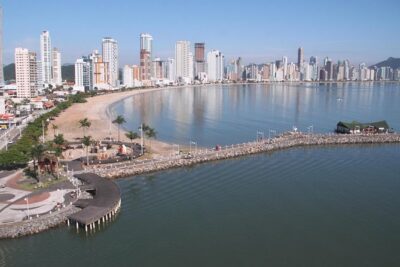
Balneário Camboriú tour and cable car ride from Florianópolis
Read our review →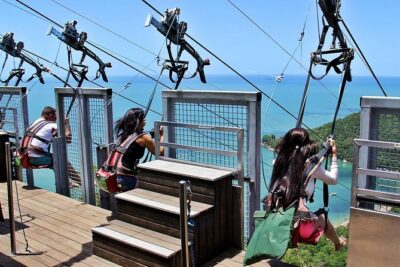
Balneário Camboriú, Unipraias and Laranjeiras – Exit Floripa
Read our review →
Florianópolis: Camboriu & Unipraias Park with Cable Car Ride
Read our review →
Floripa Total – Leaving Florianópolis by Itaguasul Turismo
Read our review →

Paragliding flight with instructor in Florianópolis
Read our review →
Discover Florianópolis: Full Day City Tour and Local Highlights
Read our review →Browse the lists this tour appears in