
Our review · SALVADOR TOURS
Full-Day Historic Private City Tour of Salvador with Lunch
Salvador’s story comes into focus when you connect its forts, churches, markets, and Afro-Bahian traditions in one long day. This private tour moves from the city’s first beach and Santo Antonio da Barra Fort to Pelourinho’s cobbled squares, with a guide explaining how Portuguese Catholicism and African beliefs shape local life.
I like the private vehicle and flexible guide service, especially for a city spread across hills and waterfront districts. I also like the mix of grand sights and small local stops, including a tile painter’s studio, a traditional ice-cream shop, and lunch at a local restaurant. The main drawback is pace: with so many stops, you will walk a lot and may feel rushed in Pelourinho or at the churches.
Key points
- A full Salvador overview in eight hours: Cover forts, churches, markets, viewpoints, museums, and the old city without arranging several separate outings.
- Private transport with pickup and drop-off: Your guide and air-conditioned vehicle save time between Salvador’s widely scattered sights.
- A strong focus on Afro-Bahian culture: Learn about Candomblé, Catholic saints, and the orixás represented at Dique do Tororó and Bonfim.
- Two major historic churches included: See the Cathedral Basilica and Igreja e Convento de São Francisco without paying separate entrance fees.
- Lunch and local tastes are part of the day: Bahia’s food is included at a local restaurant, while drinks, ice cream, and coconut water cost extra.
- A packed schedule: The itinerary offers breadth rather than long, quiet visits at every stop.
Why this private Salvador tour works
At $170 per person, this is not the cheapest way to see Salvador. It is priced as a private, full-day outing with hotel or port pickup, an air-conditioned vehicle, a professional guide, and lunch. For two people, the cost buys convenience and a personal schedule. For a larger private group of up to 15, the price may feel more reasonable, depending on the final group size.
I see the value in the transportation. Salvador’s main sights are not gathered in one compact center. Barra, Bonfim, Dique do Tororó, Ribeira, Cidade Baixa, and Pelourinho are spread across the city, and moving between them by car lets you cover much more than you could on foot.
The tradeoff is that the tour tries to do nearly everything in one day. The listed stops add up to more than six hours of visits before driving, lunch, and transitions. You get a useful first look, but this is not the right choice if you want to linger over every church, museum, or market stall.
More City Tours in Salvador
- Afro-Brazilian Roots Private City Tour in Salvador
★ 4.7 · 88 reviews - City Tour in Salvador discover the first capital of Brazil
★ 5.0 · 69 reviews - Historical African oriented City Tour
★ 5.0 · 52 reviews
Starting by Salvador’s first beach
The day begins at the beach associated with the Portuguese colonizers’ arrival in Salvador. It gives you a useful geographic starting point before the tour turns to forts, churches, and the old city.
At Santo Antonio da Barra Fort and the Nautic Museum of Bahia, you have about 20 minutes for photos and a short walk with your guide. The fort is an important landmark at the entrance to the bay, but entry is not included. You can go inside by paying R$12 per person, though the schedule may not leave much time for a full visit.
I would treat this as a photo stop unless the fort itself is a priority. Ask your guide at the start of the day how much time is available if you want to pay for entry. That small decision matters because the schedule already has many fixed stops.
The route also passes colonial buildings connected with art and museums, including a silver art collection and a wood-and-painting museum. The information provided does not promise interior visits at these points, so expect these to be brief looks or explanations from the vehicle rather than full museum tours.
There is also a drive-by photo stop at an independence monument. You do not get out for a walking visit, but it adds a little political context to the city’s colonial and national story.
A working artist’s tile studio
At Atelier Casa de Prentice on Rua Augusto de Mendonça, you spend about 15 minutes visiting a local tile painter in the studio. This is one of the more personal stops on the route.
The appeal is simple: instead of seeing only finished monuments, you get a glimpse of a living craft tradition. The visit is free, and you may find it more memorable than another quick photo beside a large building. Since the stop is short, it is best approached as an introduction to the artist’s work rather than a full workshop visit.
Bonfim Church and Bahia’s religious blend
The Basilica do Senhor do Bonfim receives about 30 minutes. This is a key stop for understanding Salvador’s religious life, not just a church photo.
Your guide explains the relationship between Catholic devotion and African religious traditions. In Bahia, Catholic saints and Candomblé orixás are often discussed within the same cultural setting, and Bonfim is a useful place to hear how local beliefs developed.
The tour’s attention to Candomblé is one of its clearest themes. One guide, Marcos, was described as especially strong on Salvador and able to explain the subject in detail, though his presentation reportedly focused heavily on it. That can be a plus if you want cultural context, but you can also tell your guide if you would prefer more time on architecture, politics, or daily life.
The church visit is free. You will want comfortable shoes and a little patience, since the day continues with considerable walking later on.
more Salvador days to choose between
- Salvador: Anthropological City Tour with Lunch IN 6 HOURS
★ 4.9 · 20 reviews - From Salvador: Quilombo Heritage Daytrip with Lunch
★ 3.4 · 3 reviews - Rio de Janeiro: 6-Stop Highlights of Rio with Lunch
★ 4.4 · 5,157 reviews - Rio: Christ the Redeemer, Sugarloaf, Selaron & BBQ Lunch
★ 4.5 · 2,428 reviews
Orixás at Dique do Tororó
Dique do Tororó offers a different kind of cultural sight. The lake is known for its large images of African orixás, and the tour allows about 20 minutes to see them from outside. You also get a view of the football stadium.
This short stop works well because it connects public art with the religious traditions discussed at Bonfim. It is not a formal museum visit. You are mainly taking in the setting, listening to the guide, and making photographs.
The stop also breaks up the church visits. Salvador can become a blur of ornate interiors and colonial façades, so a lakeside pause gives the day some visual variety.
Mercado Modelo, souvenirs, and the limits of shopping time
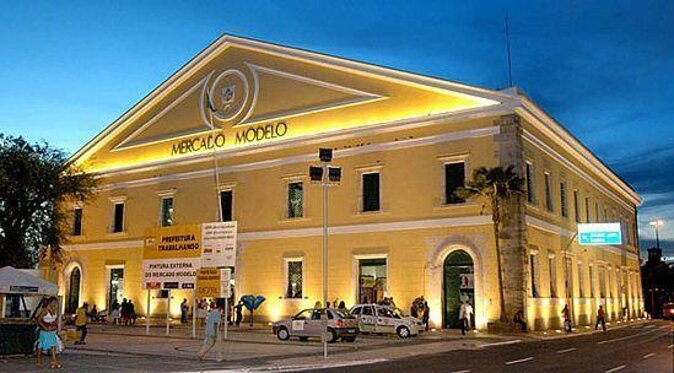
At Mercado Modelo, you have about 45 minutes to browse local crafts and buy souvenirs. Admission is free.
This is a practical shopping stop, not necessarily the most intimate cultural encounter of the day. You will find the kind of handmade goods and keepsakes many people want after visiting Bahia, but a market can also take time away from historic sites if you are not interested in shopping.
The schedule gives you enough time to look around without turning the whole afternoon into retail. I suggest deciding in advance if you want souvenirs, since bargaining, comparing items, and carrying purchases can eat into the rest of the day.
The lunch stop is at a local restaurant, with lunch included in the tour price. The exact restaurant and menu are not specified, so you should ask about the meal if you have dietary restrictions. Drinks are not included. This is your main chance to try Bahian specialties as part of the organized day, rather than hunting for a restaurant between sightseeing stops.
Walking through Pelourinho’s five squares
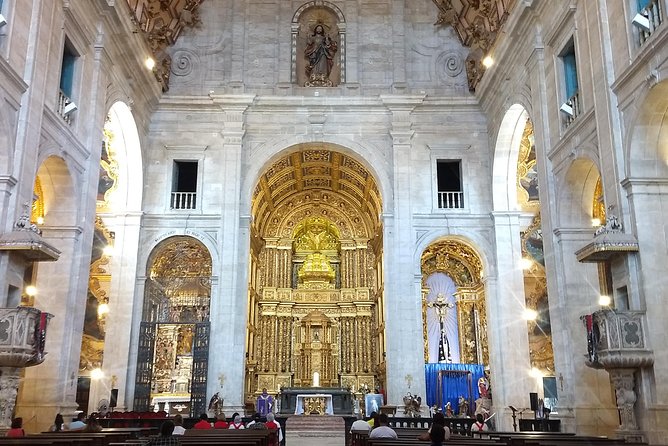
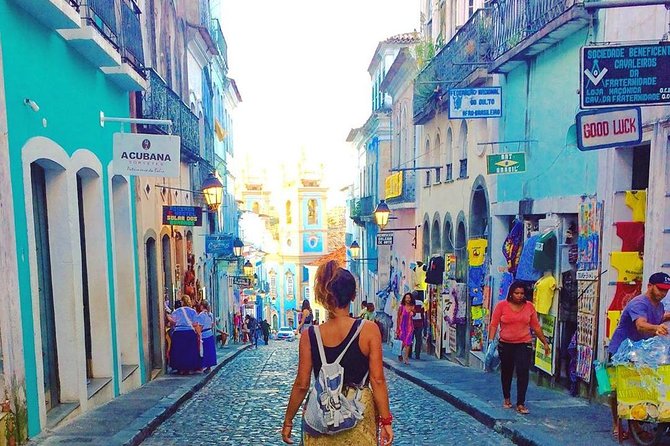
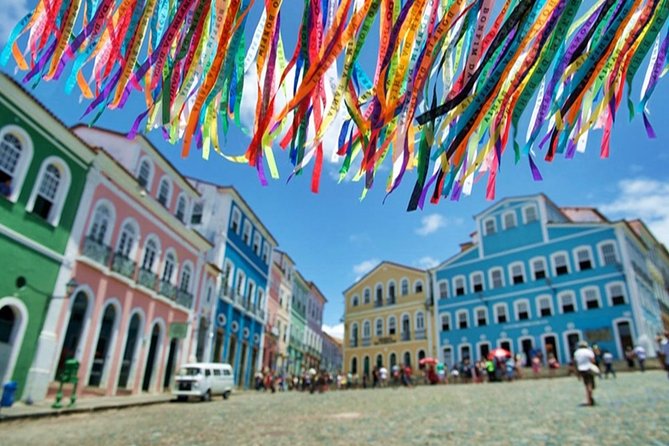
Pelourinho receives the longest scheduled visit, about two hours, and rightly so. This is the heart of the walking portion, with cobbled streets, colonial buildings, and a group of five historic squares.
Here the guide’s explanations matter more than the number of façades you photograph. Salvador’s old center is easier to understand when someone points out the connections between religion, slavery, trade, government, and Afro-Bahian culture. You should expect a lot of walking on uneven cobblestones, with stops for stories and photographs.
The schedule is generous compared with the other stops, but two hours can still pass quickly. One guide, Marcos, was praised for his English and his familiarity with the city, though one account found that he sometimes allowed people to wander on their own at major sites instead of pointing out every detail. If you want close guidance inside a church or square, ask directly rather than assuming the guide will lead every minute.
Pelourinho is also where the tour may feel rushed. A French-speaking guide has been described as attentive and able to handle the day well, but the sheer number of stops means you cannot treat the old city as a leisurely half-day walk. Wear shoes with firm soles, keep water handy, and save some energy for São Francisco.
Rio Branco Palace and Bahian photography
Palacio Rio Branco is an optional 15-minute stop. The building is associated with the state governors and the republican period, and its architecture makes it worth a look from outside.
Interior access is not guaranteed because opening hours are irregular. Think of this as a useful bonus, not a central promise of the tour. If the palace is closed, the day still includes plenty of major interiors.
The Espaco Pierre Verger da Fotografia Baiana gets about 10 minutes. It focuses on photography of the Afro-Bahian diaspora. The visit is brief, so you should not expect a full museum experience, but the subject adds an important visual record to the day’s discussion of identity and culture.
Ice cream in Ribeira
Sorveteria da Ribeira is a pleasant change of rhythm. The shop has made ice cream since 1931, and you can stop for one flavor at R$10 per scoop.
Ice cream is not included, so bring Brazilian reais if you want one. The stop takes about 20 minutes and gives you a chance to sit, cool down, and try a long-running local favorite after the walking sections.
This is the sort of small food stop that makes a city tour feel less like a checklist. It is optional in practical terms, but I would budget for it unless you are already full from lunch.
Cathedral Basilica and São Francisco’s gold
The Cathedral Basilica of Salvador is an included 30-minute visit. The church is known for its Jesuit art, and the interior gives you a strong sense of the wealth and religious power that shaped colonial Salvador.
I would pay attention to how different this feels from Bonfim. Bonfim helps explain living religious practice and the meeting of Catholic and African traditions. The cathedral shows the formal side of colonial Catholicism through architecture and decoration.
Igreja e Convento de São Francisco is another included interior visit, also scheduled for 30 minutes. It is known for its Portuguese tile collection and extensive gold-leaf decoration. This is one of the artistic high points of the day.
Thirty minutes is enough to see the main interior, but not enough to study every tile panel or carved detail. One useful caution is that guide involvement may vary inside the churches. If you want an explanation of a particular altar, tile scene, or architectural feature, point to it and ask. Do not be shy about requesting more context before the group moves on.
Lacerda Elevator and the lower city
The Lacerda Elevator visit lasts about 15 minutes, with entry included. You ride between Salvador’s upper and lower sections, gaining a direct experience of how the city’s two levels connect.
The ride itself is short, but its importance is larger than its length. It is both a working piece of urban infrastructure and one of Salvador’s best-known landmarks. The elevator also helps you understand why private transport is useful on this tour. The city’s vertical layout can make a simple route feel surprisingly complicated.
You may not have time for a long pause at the viewpoints, so keep your camera ready. The elevator is part of the tour rather than a separate attraction requiring extra planning.
Monte Serrat views and a coconut-water pause
Forte de Nossa Senhora de Monte Serrat provides another photo opportunity. The fort belongs to the Army and is closed to visitors, so you walk around the outside rather than enter.
The setting gives you a special view over Salvador. You can also buy coconut water for R$5 per person. Like the ice cream stop, this is a small extra cost, but it can be welcome after a long day in the heat.
Do not book this tour expecting access to every fort. Santo Antonio da Barra may be entered for an added fee, while Monte Serrat is seen from outside. The tour is about viewpoints, history, and orientation rather than a series of complete fort museum visits.
How the guide shapes the day
The guide is the most important variable in a private tour. The experience has included guides named Andre and Marcos, and the available feedback describes both strong city knowledge and different guiding styles.
Andre was praised for being kind, flexible, and considerate of physical limitations. That matters here because the day includes cobbled streets, church interiors, markets, and repeated walks between stops. If you have mobility concerns, tell the provider before the tour and explain what kind of pace works for you.
Marcos was praised for very good English and a strong grasp of Salvador. At the same time, one account found that he sometimes gave less explanation inside São Francisco and in the main square than expected. This is a useful reminder to speak up. A private format gives you a better chance to request more detail, a slower pace, or a stronger focus on art and architecture.
The tour also has language flexibility, with a French-speaking guide described as handling the city well. The specific guide assigned to your date is not guaranteed, so confirm language needs when booking.
Who should book this eight-hour outing?
I would choose this tour if you have one full day in Salvador and want a broad introduction without arranging transport between distant neighborhoods. It suits first-time visitors, couples, families, and small groups who value a private vehicle and a guide’s interpretation.
It also works well for a port day because hotel or port pickup and drop-off are included. The eight-hour length gives you a useful overview, though you should confirm that the timing fits your departure plans.
I would be more cautious if you dislike packed schedules, shopping stops, or walking on uneven streets. You might prefer a shorter private tour focused only on Pelourinho and the major churches. This outing is designed for breadth, not a slow study of one district.
The tour requires at least two people per booking and can accommodate a maximum of 15. Most people can participate, and the vehicle is air-conditioned. The private label suggests a personal experience, but a larger booking can feel less intimate than a tour for two or four.
Practical costs and cancellation
The $170 price includes lunch, the guide, transport, hotel or port pickup and drop-off, and admission to the Cathedral Basilica, Lacerda Elevator, and São Francisco Church and Convent. You still need money for drinks, Santo Antonio da Barra Fort entry at R$12, ice cream at R$10 per scoop, and coconut water at R$5.
Free cancellation is available if you cancel at least 24 hours before the start time. Changes or cancellations made within 24 hours are not accepted for a refund, and the cut-off follows Salvador’s local time.
Should you book the Salvador private city tour?
Book it if you want to see the city’s main districts, churches, forts, viewpoints, and cultural landmarks in one organized day. The strongest reasons are the private transportation, included lunch, solid coverage, and attention to the links between Catholic practice and Afro-Bahian traditions.
Skip it if you want long museum visits or an unhurried Pelourinho walk. The schedule is ambitious, and even a good guide cannot make every stop feel spacious.
For most first visits, I think the tradeoff is fair. You will leave with a clear sense of how Salvador fits together, plus a few specific memories: the orixás at Dique do Tororó, gold inside São Francisco, a ride on Lacerda Elevator, and ice cream in Ribeira. Just wear comfortable shoes, budget for small extras, and tell your guide what you most want to understand.
FAQ
How long does the Salvador private city tour last?
The tour lasts approximately eight hours.
What is included in the price?
Lunch, a professional guide, hotel or port pickup and drop-off, and an air-conditioned vehicle are included.
Are drinks included with lunch?
No. Drinks are not included.
Is entry to Santo Antonio da Barra Fort included?
No. Entry is optional and costs R$12 per person.
Which attractions include admission?
Admission is included for the Cathedral Basilica of Salvador, Lacerda Elevator, and Igreja e Convento de São Francisco.
How many people can join the tour?
The tour requires a minimum of two people per booking and has a maximum group size of 15 travelers.
Can I cancel for a full refund?
Yes. You can receive a full refund if you cancel at least 24 hours before the experience start time. Cancellations or changes made less than 24 hours in advance are not accepted for a refund.
More Full-Day in Salvador
- Private Full-Day Tour – Salvador’s Lower & Upper City
★ 5.0 · 48 reviews - Rio de Janeiro: Angra dos Reis and Ilha Grande Full-Day Tour
★ 4.6 · 1,673 reviews - Iguazu Falls: Full-Day Tour of Brazil & Argentina Sides
★ 4.9 · 1,542 reviews - Full Day Tour to Angra dos Reis and Grand Island
★ 4.0 · 469 reviews
More History Walks in Salvador
- Salvador Historic Walking Tour – Pelourinho
★ 4.8 · 62 reviews - Historic City Tour in Salvador
★ 3.6 · 17 reviews - Rio de Janeiro: Historic Rio and Santa Teresa Half-Day Tour
★ 4.4 · 228 reviews - São Paulo: Downtown Historical Bike Tour
★ 4.9 · 191 reviews
New in Salvador this month
- From Salvador: Schooner Tour to Frades Island★ 3.9 · 3 reviews
- From Salvador: Quilombo Heritage Daytrip with Lunch★ 3.4 · 3 reviews
- Salvador: Caipirinha Masterclass with Unlimited Drinks★ 4.2 · 4 reviews
- Salvador: Schooner Cruise with Pickup and Itaparica Stop★ 3.8 · 5 reviews
- BOXE CLASS – EX BAHIAN CHAMPION (SALVADOR-BA)★ 5.0 · 7 reviews
- Salvador by Night: Pelourinho & Old Town Tour★ 4.3 · 8 reviews
- Salvador: 3-Hour Percussion Class★ 4.9 · 10 reviews
- Salvador: Traditional Drumming and Percussion Workshop★ 4.4 · 10 reviews
Salvador Tours, compared.
Cooking class in Salvador, an authentic dinning experience
Read our review →
Tour to the Frades Islands and Itaparica, from Salvador – Ba
Read our review →
From Salvador: Schooner Tour to Frades Islands and Itaparica
Read our review →
Tour Praia do Forte and Guarajuba, Leaving Salvador-Bahia.
Read our review →
Afro-Brazilian Roots Private City Tour in Salvador
Read our review →

Schooner Trip Only Ilha dos Frades, Leaving Salvador-Bahia.
Read our review →Browse the lists this tour appears in